Monday, May 11, 2020

English WB 11.05.20

Writing 
These 5 lessons are based on: Ruckus https://www.youtube.com/watch?v=Ji1KM1BbAyY

About the film:
"Ruckus is a short animation film about two bandit brothers.  Frank and Jason are Wanted, but they are still carrying out daring robberies, this time it seems is the great train robbery, however, will their greed be the end of them?"

Lesson 1: LO to understand the thoughts and motives of a character
Before watching the film:
- Predict what you think will happen

Task 1: 
After watching: 
- Which brother do you think is Frank and which one do you think is Jason? Why do you think this?
- What differences and similarities have you noticed between the brothers?
- What question would you ask your favourite character?
- What were the brothers attitudes towards each other at the beginning and end of the story?
- Do you think there is a moral of the story?
- What do you think will happen next?

Task 2:
Draw a scene from the story and annotate it with the characters' thoughts and feelings. Remember to use conjunctions to extend your sentences E.g because, as, since 


Lesson 2 - LO to write a setting description
Replay the film 'Ruckus' before beginning the lesson. 
Task 1
Think of the dessert surrounding in the film and write a list of things that you see. Here are some words and images to help you: 


Task 2: Write a description about the desert
To write your setting description, think about:
What would you see?
What would you hear?
What would you smell?
What would you touch?

Example description starter:

The desert was a furnace. A land of burning sand. Huge sand dunes had been blown away by the sand storm and dumped elsewhere. The endless, flat horizon, was suddenly broken by tall rock pillars like mushrooms


Lesson 3: LO to write from the perspective of a character.
In the film there is no dialogue however the characters' actions give us some clues about what they could be saying. In the lesson today, you are going to write the possible dialogue between the brothers at different points of the film. Remember to punctuate speech using inverted commas " ". You must also start each line of speech with a capital letter and remember the punctuation such as ,.!? before your closing inverted commas  

Task 1: "Who said it?"
To get you thinking about what the characters might say, look at the quotes in the image. For each quote, decide if Jason or Frank said it and explain why you think this. 
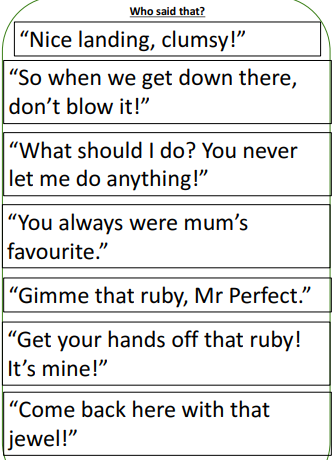
Task 2:
Write the dialogue between the brother at these points in the film:
1) When they open the door and spot the diamond
2) When they are fighting about the ring
3) When they are in hospital

Lesson 4 - LO to write a character description 
The lesson today will be linked to Lesson 5 when you will be using your character description to complete your wanted poster. 


Task 1:
Using the example character description, look for the following features:
- Expanded noun phrases
- Conjunctions 
- Rich vocabulary 

Task 2:
Use the example character description about Frank to write your own character description about Jesse.


Lesson 5 - LO to design a wanted poster 
Example:


Your wanted poster must include:
- A description of the brothers
- The crimes that they are wanted for
- A sketch of them
- Details of the reward


You can use the character description that you wrote in Lesson 4 to publish your wanted poster
Take a picture of you wanted poster for us to see!

Reading


Hi Y3/4 Here is this week's reading fluency lesson for you on Youtube https://youtu.be/LXQSzXsNKek
Thanks Miss Davies


SPaG
Practise the Year 3/4 for Common Exception words. 
● Practise your spelling on Spelling Shed 
● Practise your spelling on Spelling Frame 
● Choose 5 Common Exception words. Write a synonym, antonyms, the meaning and an example of how to use the word in a sentence. Can the word be modified?
 ● Choose 5 Common Exception words and practise spelling them using across and down. Write the word across the page then down the page, e.g
s p e l l i n g 
p
e
l
l 
i 
n 
g


Monday, May 4, 2020

RE

AQA RE GCSE key quotes display. Christianity and Islam | Teaching ...

Hello year 3!
Please watch this short video.
Please watch the video again and think about these questions.
What is fasting?
Who is expected to fast?
When do Muslims fast?
Why do Muslims fast?
Please write down your answers to these questions. You can use your exercise book with lines or any piece of paper.

Hope you are well,
Miss Ali

Miss K's little message WB 04.05.20

What Is the Rainbow Color Order? Understanding ROYGBIV

Hiya Year 3. I hope that you and your family are well.

 I have posted some more home learning work below so try to work through as much as you can. Remember you can also use https://www.thenational.academy/online-classroom & https://www.bbc.co.uk/bitesize/dailylessons for additional home learning lessons.  If there is anything that you are unsure of, please comment below and I will help you out. 

Take care 

Miss Kondwani :)

Sunday, May 3, 2020

Other subject WB 04.05.20

Maths

Please continue to learn your times tables up to 12 x 12

Our maths topic is 'Fractions'

Follow the link to see ‘Summer Term Week 1’ fractions lessons.

https://whiterosemaths.com/homelearning/year-3/


1) Watch the teaching video
2) Complete the activity sheet
3) Ask an adult or sibling to mark your work using the answer sheet
There are a total of 5 maths lessons!

Please log in to you Matheletics account as I have set some problem solving fraction challenges for you. 

 Other maths tasks

  • Play on Hit the Button - focus on number bonds, halves, doubles and times tables.
  • Adding totals of the weekly shopping list or some work around money. This game could support work on adding money.(Internet explorer only)
  • Practise telling the time. This could be done through this game (scroll down to access the game). Read to the quarter hour and the nearest 5 minutes.
  • Get a piece of paper and ask your child to show everything they know about Subtraction. This could be pictures, diagrams, explanations, methods etc. They can be as creative as they want to be.
  • Go through some of the questions here on subtraction.
  • Practise counting forwards and backwards from any given number in 5s


    Science  The focus is Plants
    Watch he clip titled What does a plant need to live?
    Video 1: https://www.bbc.co.uk/bitesize/topics/zy66fg8/articles/zcmtk2p
    Home investigation: What do plants need to grow well? Use the sheet below to plan your investigation to see what key things are needed for plant growth. Ask an adult if you can use a plant to investigate the changes.


    Madame Cartlidge’s French at Home

    Bonjour les enfants !

    For French this week, use this dictionary to make a list of French words (E.g animals, hobbies, sports, school subjects, weather.. )

    https://www.collinsdictionary.com/translator


              Be Creative


    (If you have not got different pieces of coloured paper then you could draw or cut squares and then colour them in.) 

    Music
    Go to YouTube as Myleene's Music Klass


    Be Active:

    Joe Wick is putting on a PE at home lesson daily find him at P.E with Joe on youtube


    https://www.youtube.com/watch?v=Rz0go1pTda8 


    Go for a walk or cycle but take social distancing precautions follow current government advice

    English WB 04.05.20

    Writing

    These 4 lessons are based on the dreamgiver www.literacyshed.com/dreamgiver

    lesson 9
    LO I am learning to write a recount

    Share the BFG trailer  http://www.literacyshedblog.com/blog/teaser-trailer-the-bfg
    Discuss how they would feel if they saw The BFG in the street.  Watch the opening of ‘The Dreamgiver’
    up to 57 seconds.  We do not see anyone in the film, but imagine if someone was looking out of their
    window and they saw ‘The Dreamgiver’ what would they think?

    Task
    Write an eyewitness report of what you saw include
    • your name
    • where you were when you saw it
    • the time you saw it
    • what you saw
    Remember to use factual descriptions ( expanded nouns), time conjunctions, prepositions and write in 3rd person

    Then write what 2 other witnesses saw of the dream giver.

    Here's an example of an eyewitness account
    Mrs Smith said that she was soundly sleeping in her bedroom when her cat suddenly 
    howled behind the curtains so she got out of bed it was about 1.30 am. Then she walked
    over to where her cat was  in her flowery nightdress and looked through the window.  
    There she saw a strange glowing thing zoom towards the orphanage window,
    and she felt scared.


    lesson 10
    LO I am learning to use indirect reported speech.
    Be ready for this task by reminding yourself of your headlines and orientations from previous session
    ( see wb 27.4.20) You should also have completed witness statements too from lesson 9
    Demonstrate how to turn this information into a newspaper recount. Explain that we will only be
    telling the story of The Dream Giver entering the orphanage, as no one else knows what happened
    inside

    Task
    Change your eyewitness statements from session 9 into indirect reported speech.

    Reported speech is how we represent the speech of other people or what we ourselves say. There are two main types of reported speech: direct speech and indirect speech. Direct speech repeats the exact words the person used, or how we remember their words: Barbara said, “I didn’t realise it was midnight.”
    In indirect speech, the original speaker’s words are changed.
    Barbara said she hadn’t realised it was midnight.
    Here is my demonstration of  how to use small extracts of what they have recorded rather than
    copying it out verbatim.
    For example:  Mrs Smith said that she was soundly sleeping when her cat suddenly howled
     behind the curtains so she got out of bed and looked through the window in her 
    flowery nightdress and saw a strange glowing thing zoom towards the orphanage window,
    and she felt scared.
     - may become- Mrs Smith told reporters that her cat had started howling at a strange glowing object which 
    shot across the dark sky. Discuss which information is relevant/irrelevant –we do not need to know that Mrs Smith was in her nightdress 

    Lesson 11
    LO to write a newspaper report  

    Use your headline and orientation that you wrote last week and the reported indirect speech from lesson 10

    Task

    We will only be telling the story of The Dream Giver entering the orphanage, as no one else knows what 
    happened inside. Look at the headlines  you wrote last week  which is most effective? once you've decided write your headline in big bold writing using a couple of lines and writing across the whole page. Next divide the rest of the page vertically down to form a newspaper template and write out your orientation making sure it briefly lays out the 5 ws.
    Then write out your orientation that you wrote last week in the left hand column. draw a picture and write a caption underneath to go with the article.


    lesson 12
    LO recount events in detail to write a newspaper report


    Watch the opening of ‘The Dreamgiver’ up to 57 seconds. write the 5w who, what, where, when and why

    Explain that, in order to flesh out the story, you could include information about this also happening in other
     towns or quotes from the police/experts. You could also offer several ‘theories’ as to what is happening.

    Task
    Finish the newspaper report that was started in lesson 11.  recount the information in the orientation but in more detail. Remember to 


    • write in past tense
    • retail the events in order of time and in greater detail
    • use time conjunctions to link e.g
    • use factual expanded nouns
    • eye witness direct and indirect speech
    • conclude the report by including an update to tell the reader what is happening now

    Reading

    Listen to your child read and let them discuss what they have read. Encourage them to read with expression and intonation.
     ● Watch Newsround and discuss what is happening in the wider world.  
    ● Get your child to read a book on Oxford Owl, discuss what your child enjoyed about the book.  
    ● Get your child to read and complete the activities. These focus on comprehension skills. Sound Waves 
    ● Explore new vocabulary you find when reading. What are the origins of this word? Can it be modified? Can you find any synonyms or antonyms for your new word? 
     ● With your child, look in magazines, newspapers and books for new vocabulary they are unfamiliar with. They could use a highlighter to highlight in magazines and newspapers.


    Wb 4/5/20 Miss Davies’ performance poetry family task
    Work together to learn and perform this poem.
    Be careful if you are doing this one indoors with a real ball!
    What
    Can You
    Do With A
    Football
    ?
    Well...
    You can
    kick it you can catch
    it you can bounce it – all
    around. You can grab it you can
    pat it you can roll it – on the ground.
    You can throw it you can head it you
    can hit it – with a bat. You can biff it
    you can boot it you can spin it you
    can shoot it you can drop it
    you can stop it – just
    like that!
    Copyright © James Carter
    From 
    Journey to The Centre Of My Brain (Macmillan Children's Books, Jan 2012)

    SPaG
    Practise the Year 3/4 for Common Exception words. 
    ● Practise your spelling on Spelling Shed 
    ● Practise your spelling on Spelling Frame 
    ● Choose 5 Common Exception words. Write a synonym, antonyms, the meaning and an example of how to use the word in a sentence. Can the word be modified?
     ● Choose 5 Common Exception words and practise spelling them using across and down. Write the word across the page then down the page, e.g
    s p e l l i n g 
    p
    e
    l
    l 
    i 
    n 
    g